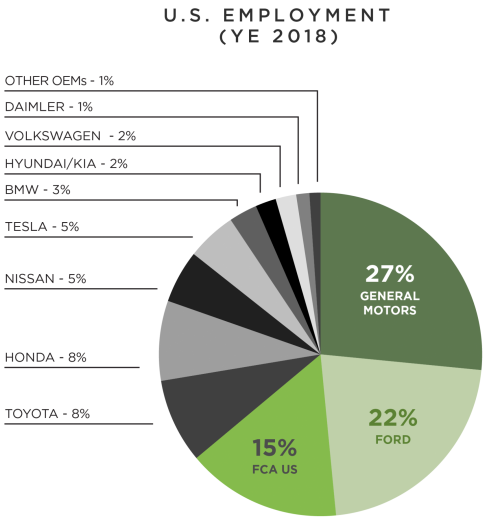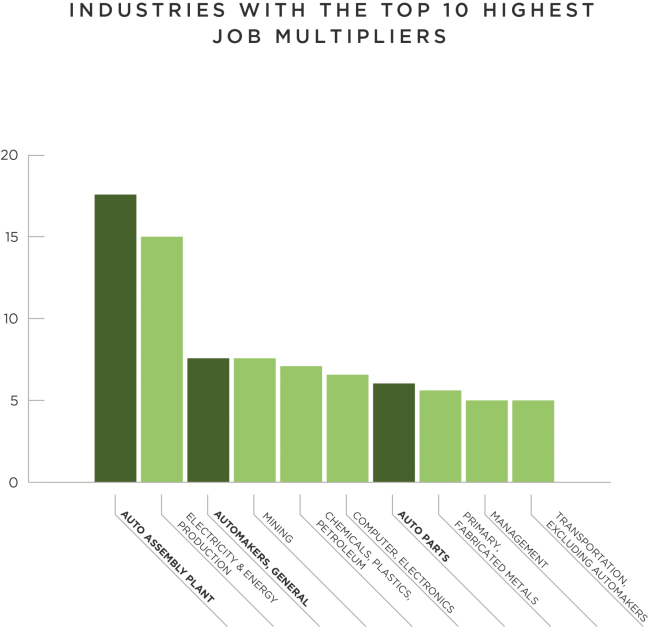



From research labs and supplier factories to assembly lines and dealership showrooms, the auto industry supports nearly 8 million jobs, pays $500 billion in annual compensation and generates $70 billion in personal tax revenue in the United States.
And, as low-skill manufacturing has shifted overseas (for example, in textiles or some consumer electronics), the importance of high-skill manufacturing, like automobiles, has risen. With auto sales rebounding from the financial crisis of the 2008 – 2009, automakers’ importance to our economy will continue to grow. Industry experts predict Chrysler, Ford and GM could hire 34,000 new workers over the next four years. And those new jobs will support about 300,000 more new jobs at auto suppliers and other local businesses that serve Chrysler, Ford and GM plants.
Chrysler, Ford and GM are just three of 16 major global automakers competing in the U.S., but they employ two-thirds of America’s autoworkers, purchase nearly two-thirds of the auto parts manufactured here, produce 55 percent of the autos assembled here and conduct most of America’s auto research and development.
Why do Chrylser, Ford and GM contribute so much more to our economy? Because they conduct the bulk of their engineering, manufacturing, marketing and finance work here. Four out of 10 Chrysler, Ford and GM employees are based in the U.S. At Toyota, Honda, Nissan, Hyundai/Kia, BMW, Mercedes and VW (the seven largest foreign automakers), only five in 100 employees are based here. That eight-fold difference translates into millions of U.S. jobs and tens of billions of dollars in parts sales, R&D and capital investment each year.
The Commerce Department reported today that spending on vehicles and parts jumped 1.8 percent in May and 8.5 percent from May of last year. This is the biggest monthly jump in half a year and shows that consumer spending is resilient in the face of a soft economy. Earlier this month, General Motors, Ford, Chrysler, and Toyota reported a 12 percent jump in cars sold in May from the month before and 7 percent from May, 2012. And the data isn’t just in cars sold and dollars spent, but all over the auto economy.
Ford Motor plans to add 800 more white-collar workers by the end of 2013 after already signing on 2,200 so far this year. It's the latest indication that while U.S. employers, on the whole, remain reluctant to put out the help-wanted sign, the auto industry is struggling to find enough bodies to keep up with the strong surge in domestic sales.
Most of the 3,000 new white-collar jobs Ford now plans to fill this year will be focused on engineering, information technology, product development and manufacturing, primarily in southeastern Michigan. But it is also moving to find thousands of additional hourly workers to keep its assembly lines rolling. And it's not alone.
Ford will add 800 more salaried workers this year than the 2,200 white-collar workers the automaker thought it would need to meet growing demand for new vehicles.
Ford continues to grapple with a good problem: how to make enough cars when the industry is on pace to sell more than 15 million new vehicles in the U.S. this year.