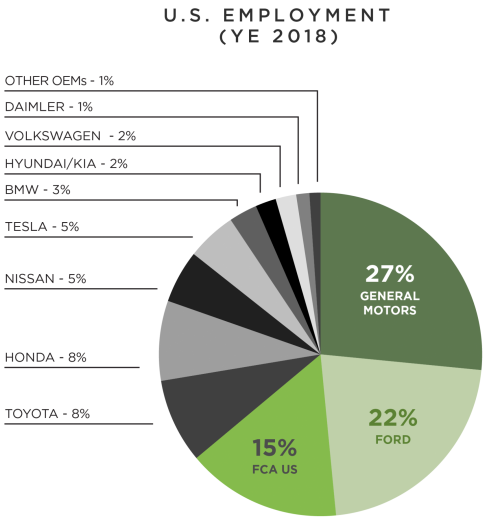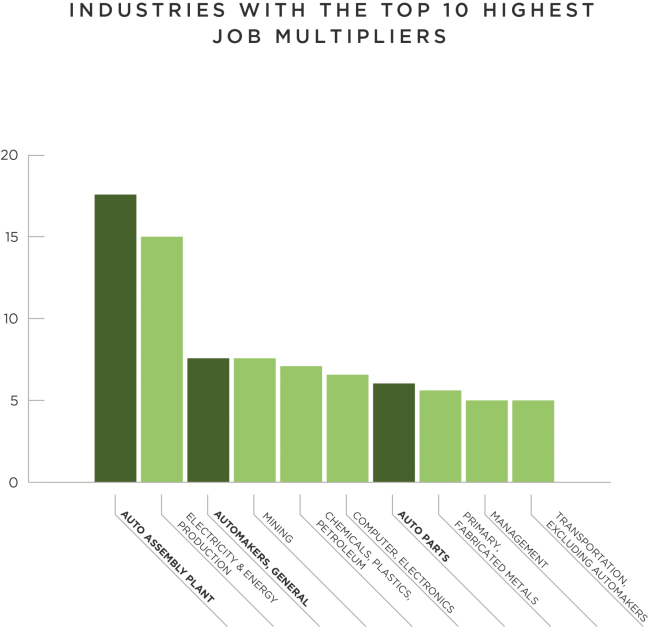



From research labs and supplier factories to assembly lines and dealership showrooms, the auto industry supports nearly 8 million jobs, pays $500 billion in annual compensation and generates $70 billion in personal tax revenue in the United States.
And, as low-skill manufacturing has shifted overseas (for example, in textiles or some consumer electronics), the importance of high-skill manufacturing, like automobiles, has risen. With auto sales rebounding from the financial crisis of the 2008 – 2009, automakers’ importance to our economy will continue to grow. Industry experts predict Chrysler, Ford and GM could hire 34,000 new workers over the next four years. And those new jobs will support about 300,000 more new jobs at auto suppliers and other local businesses that serve Chrysler, Ford and GM plants.
Chrysler, Ford and GM are just three of 16 major global automakers competing in the U.S., but they employ two-thirds of America’s autoworkers, purchase nearly two-thirds of the auto parts manufactured here, produce 55 percent of the autos assembled here and conduct most of America’s auto research and development.
Why do Chrylser, Ford and GM contribute so much more to our economy? Because they conduct the bulk of their engineering, manufacturing, marketing and finance work here. Four out of 10 Chrysler, Ford and GM employees are based in the U.S. At Toyota, Honda, Nissan, Hyundai/Kia, BMW, Mercedes and VW (the seven largest foreign automakers), only five in 100 employees are based here. That eight-fold difference translates into millions of U.S. jobs and tens of billions of dollars in parts sales, R&D and capital investment each year.
General Motors Co. Chairman and CEO Dan Akerson on Thursday returned to his hometown of Mankato, Minn., to award two students at Mankato West High School with new college scholarships each worth $40,000.
U.S. auto makers are accelerating production lines and, in some cases, even canceling the North American industry's traditional summer factory shutdowns to meet strong demand.
The plans highlight the Detroit Three auto maker's recent market share gains against Japanese rivals and the auto industry's prime position in the U.S. economic recovery. Car sales have roared ahead this year even as retail spending on clothing and other goods remains tepid.
Ford Motor Co. plans to ramp up production to meet growing demand.
The Dearborn, Mich.-based auto giant plans to idle its plants for one week this summer, as opposed to the usual two weeks, so it can produce an additional 40,000 units, according to a news release from the company.